Inside the InvoiceRapid AI-Powered Tax Engine
A Four-Layer Architecture to Streamline Tax Calculations and Reporting
Tax compliance is one of the few domains where speed alone is dangerous and accuracy alone doesn’t scale. Regulations change constantly, guidance is often ambiguous, and mistakes carry real financial and legal consequences.
InvoiceRapid’s AI-Native Tax Engine was built specifically for SaaS and AI software companies, addressing these challenges head-on. It automates VAT and Sales Tax calculations across the EU, UK, and United States by combining AI intelligence, human oversight, and deterministic execution into a single system.
At its core, the engine is built with a four-layer architecture and operates as a continuous feedback loop. Each layer has a defined role, helping SaaS companies and AI software companies achieve both speed and operational reliability.
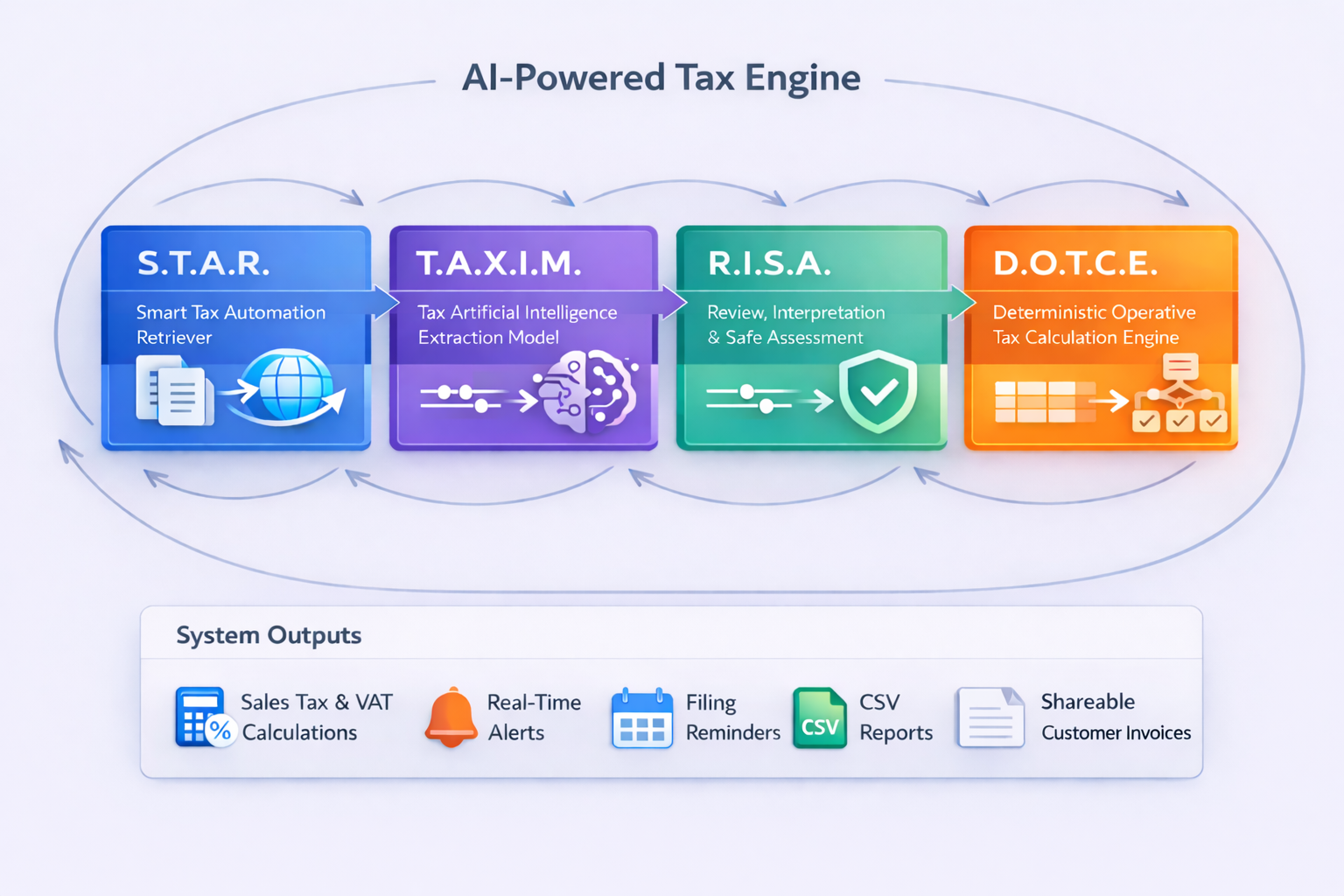
System Architecture
S.T.A.R. — Smart Tax Automation Retriever
Continuous Regulatory Awareness
S.T.A.R. is the foundation of the entire system. Its sole responsibility is to ensure that no relevant tax regulation change is missed.
This layer continuously monitors official sources, including:
- EU VAT directives and amendments
- UK HMRC updates
- US state and local Sales Tax authority publications
- Government bulletins, rulings, and interpretative guidance
S.T.A.R. does not interpret laws and does not apply rules. Instead, it:
- Captures authoritative regulatory text
- Records jurisdiction, references, and effective dates
- Flags newly published or amended rules in real time
All detected changes are passed forward as raw, unmodified source material, allowing the system to operate on complete and up-to-date regulatory inputs, forming the first stage of the feedback loop.
T.A.X.I.M. — Tax Artificial Extraction Intelligence Model
AI-Accelerated Legal Interpretation
Tax legislation is dense, technical, and often unstructured. Reading and understanding it at scale is slow for humans — but ideal for AI.
T.A.X.I.M. is InvoiceRapid’s LLM-powered interpretation layer, designed to rapidly analyze large volumes of legal text and extract tax-relevant meaning.
T.A.X.I.M.:
- Reads legislative and regulatory language
- Identifies rates, thresholds, exemptions, conditions, and edge cases
- Translates legal prose into structured interpretations
However, T.A.X.I.M. is deliberately constrained. It does not generate executable tax logic and does not calculate tax. This design reflects a core principle of the system: AI is excellent at understanding context, but unsuitable for final decision-making in regulated environments. T.A.X.I.M. accelerates understanding — nothing more. Its outputs are treated as draft interpretations, never as authoritative rules.
R.I.S.A. — Review, Interpretation & Safe Assessment
Human Oversight and Operational Control
R.I.S.A. is the critical safety layer that makes the entire system trustworthy.
In this layer, humans review and validate AI output before it is ever used in production.
Specifically, humans:
- Review T.A.X.I.M.’s interpretations
- Validate them against official guidance and authoritative sources
- Resolve ambiguities and jurisdictional conflicts
- Confirm applicability, scope, and effective dates
Only rules that pass R.I.S.A. are applied. This ensures that every rule is explainable, auditable, and traceable. R.I.S.A. transforms AI outputs into structured, deterministic tax logic, helping maintain control and transparency in automated processes.
D.O.T.C.E. — Deterministic Operative Tax Calculation Engine
Explainable, Audit-Ready Execution
D.O.T.C.E. is the only layer permitted to calculate tax.
Unlike AI systems, D.O.T.C.E. is fully deterministic:
- The same inputs consistently produce the same outputs
- All calculations are traceable and auditable
- No probabilistic reasoning is involved
D.O.T.C.E. applies only R.I.S.A. approved rules, calculates VAT and Sales Tax for each transaction, manages thresholds, exemptions, reverse charges, and special cases, generates shareable invoices instantly, produces CSV reports suitable for tax authority submission, and triggers jurisdiction-specific alerts and filing reminders. By isolating execution in a deterministic engine, InvoiceRapid reduces the risk of calculation errors and supports reliable tax processing.